2007-10-14
2007-09-15
Fragrance of Friendship
 ഒരുപാടു ദൂരെ പുഴകള്ക്കും മലകള്ക്കും കടലിനമ്മപ്പുറമാണ് നീ. നിന്റെ മണമുളള കാറ്റ് എന്നെ തഴുകുമ്പൊള് നീ ഇവിടെ എന്റെ അടുത്തു തന്നെ ഉണ്ട് എന്നു ഞാന് അറിയുകയാണ്. ഒരിക്കല് പോലും കണ്ടിട്ടില്ല. നിന്റെ സ്വരം മാത്രമേ ഞാന് കേട്ടിട്ടുള്ളൂ. പക്ഷേ ഇന്ന് എന്റെ സ്വപ്നങ്ങള്ക്കു വര്ണ്ണങ്ങള് പകരുന്നതു നിന്റെ സന്ദേശങ്ങളാണ്..........
എത്ര വിദൂരതയിലാണങ്കിലും നിന്റെ മുരളിയുടെ നാദം ഞാന് കേള്ക്കുന്നു. അത് എന്നെ വലയം ചെയ്യുമ്പോള് സൗഹൃദത്തിന്റെ വലക്കണ്ണികളില് മനസ്സു കുരുങ്ങി പിടയുന്നു. ഒന്നു കാണാന് ഒന്നു കേള്ക്കാന് വല്ലാതെ മോഹിച്ചുപോകുന്നു. സ്നേഹിച്ചും, കലഹിച്ചും, കലപിലകൂട്ടിയും വിദൂരതയിലിരുന്ന് നമ്മള് ജീവിതം ആഘോഷിക്കയാണ്. ചിത്രങ്ങളും സന്ദേശങ്ങളും കൈമാറി നമ്മള് തീര്ത്തെടുക്കുന്നത് ഒരു വര്ണ്ണപ്രപഞ്ചമാണ്. അവിടെ ഏഴല്ല ഏഴായിരം നിറങ്ങളാണ്......... സ്നേഹത്തിന്റെ, സൗഹൃദത്തിന്റെ ഏഴായിരം നിറങ്ങള്..........
നിന്റെ ഒരോ വാക്കുകളിലും നിന്റെ സാന്നിധ്യം ഞാന് അറിയുന്നു. ജോലിഭാരവും ഏകന്തതയും എന്നെ തളര്ത്തുമ്പോഴും നിന്റെ ഓരോ വാക്കും എന്നെ ഉന്മേഷവനാക്കുന്നു. രാത്രിയില് വിളക്കണച്ച് തലയിണയില് മുഖമമര്ത്തുമ്പോള് ഇരുട്ടിന്റെ ശൂന്യതയില് ഒരു ഇളംതെന്നലായി നീ എന്നെ തഴുകുന്നു. സൗഹൃദത്തിന്റെ ഊഷ്മളതയുള്ള നിന്റെ പരുത്ത കൈകള്കൊണ്ട്.....അപ്പോള് ഞാനറിയുന്നു ഇവിടെ ഞാന് ഒറ്റയ്ക്കല്ല, കൂട്ടിന് നീ എന്റെ ഒപ്പമുണ്ട് എന്ന്. ഒരു സുഖമുള്ള വേദനയായി നിന്റെ സൗഹ്യദം നീ എന്നും എന്നില് നിറക്കുന്നു.........
Wayanad-the Green Paradise of God's own country
 Introduction
Wayanad, is the most beautiful districts in Kerala (India), formed on November 1, 1980 as the 12th district curved out of Kozhikkode and Kannur districts and is situated in an elevated picturesque mountainous plateau in Western Ghats , Its is called as The Green Paradise of God"s own country. The etymology of the word Wayand is "Vayal Naadu", means the village of Paddy fields. It is a quiet place where scenic beauty, wild life and traditional matter, simplicity is a virtue and beauty still blossoms from the mountainous horizon and from the green glaze of alluring vegetation. Wayanad hills are forming a vast land mass for the wild life to move about in its most natural abode. Now the Land is famous for Black Pepper, Coffee, Tea, Cardamom, Vanila and Ginger.
History
Historically, there was organized human life existed in these parts, at least ten centuries before Christ. The two caves of Ampukuthimala located between Sulthan Bathery and Ambalavayal, with pictures on their walls and pictorial writings, speak volumes of the bygone era and civilisation. Recorded history of this district is available from the 18th century. In ancient times, this land was ruled by the Rajas of the Veda tribe then came under the rule of the Pazhassi Rajahs of Kottayam royal dynasty. After that Hyder Ali invaded Wayanad and in the days of Tipu, Wayanad was restored to the Kottayam royal dynasty. But Tipu handed over the entire Malabar region to the British, after the Sreerangapattanam truce, he made with them. This was followed by fierce and internecine encounters between the British and Kerala Varma Pazhassi Rajah of Kottayam.
Historically, there was organized human life existed in these parts, at least ten centuries before Christ. The two caves of Ampukuthimala located between Sulthan Bathery and Ambalavayal, with pictures on their walls and pictorial writings, speak volumes of the bygone era and civilisation. Recorded history of this district is available from the 18th century. In ancient times, this land was ruled by the Rajas of the Veda tribe then came under the rule of the Pazhassi Rajahs of Kottayam royal dynasty. After that Hyder Ali invaded Wayanad and in the days of Tipu, Wayanad was restored to the Kottayam royal dynasty. But Tipu handed over the entire Malabar region to the British, after the Sreerangapattanam truce, he made with them. This was followed by fierce and internecine encounters between the British and Kerala Varma Pazhassi Rajah of Kottayam.
When the Rajah was driven to the wilderness of Wayanad, he organised the war-like Kurichiya tribals into a sort of people's militia and engaged the British in several guerrilla type encounters. In the end, the British could get only the dead body of the Rajah, who killed himself somewhere in the interior of the forest. Thus, Wayanad fell into the hands of the British and with it came a new turn in the Home of this area. The British authorities opened up the plateau for cultivation of tea and other cash crops. Roads were laid across the dangerous slopes of Wayanad, from Kozhikode and Thalassery. These roads were extended to the cities of Mysore and Ooty through Gudalur. Through the roads poured in settlers from all parts of Kerala and the virgin forest lands proved a veritable goldmine with incredible yields of cash crops. Roads facilities provided opportunities for the people of outside Wayanad to flow and settle to these jungle regions.
Triebels
Triebels
Wayanad, the panoramic hill of malabar in the northern Kerala and is a homeland of various tribal communities. They can be prominently classified into
The Paniyas: A vast majority of tribes in Kerala state hail from the Paniya tribal sect. Paniyas inhabit in the regions of Wayanad and the neighboring parts of Kannur and Malappuram. The name 'Paniyaan' means 'worker' as they were supposed to have been the workers of non - tribes. Monogamy appears to be the general rule among the Paniyas but widow remarriage is allowed. They have only a crude idea of religion. Their major deity, is called 'Kali'. They also worship Banyan tree. They hesitate to cut such trees and if anyone attempts to cut such trees, they fall sick. Due to the various tribal welfare programmes by the government, a change has set in the lives of Paniyas.
The Adiyas: The Adiyas are known as 'Ravulayar' traditionally. The Adiya, like the Paniya, is one of the slave sects in Kerala. In the nuclear Adiya tribal family the husband is the head of the house. Bride price is given to the parents of the bride by the groom. Divorce, widow marriage etc., are permitted. Polygamy is also practiced. No punitive measure (like ostracizing of the sex offender, as one can see among Kurichias) is prevalent among the Adiyas for sex offences. Even if their woman commits such offences they are allowed to undergo purificatory ceremony known as 'Kalachu Veypu' to join their community back.
The Kattunayakan: The Kattunayakan community is found in Wayanad, Kozhikode and Malappuram districts. They are also called Cholanaickan, in the interior forests of Nilambur area of Malappuram, and Pathinaickans, in the plains of Malappuram districts.As their name denote, the Kattunayakan were the kings of the jungle regions engaged in the collection and gathering of forest produces. They are known as Ten Kurumar since they collect honey from the forest. They have all the physical features of a hilltribe. Their language is a mixture of all Dravidian languages.They worship animals, birds, trees, rock hillocks and snakes. They are firm believers in black magic and sorcery. They also worship their ancestors, along with worshipping Hindu deities.
The Kurichiyans: They are an agricultural tribal community. Up to some decades ago untouchability had been fairly and widely practiced by these tribals. They have clean food habits and keep their houses, premises and dress always clean. They are matrilineal and live in joint families, under the control of their chieftain called 'Pittan'. The members of the extended family work together and put their earnings in the same purse. The Kurichiyans prefer cross-cousin marriage to any other marriage alliances. They do not practice polyandry.Their social control mechanism was most efficient, offenders being excommunicated. Many of the excommunicated Kurichians are now educationally and economically better compared to the traditional Kurichians.
The Uraali Kurumas: Uralikuruma, the most versatile and colourful tribal people, is one of the rarest artisan tribes in Kerala. They are mostly found in the Wayan region. Uralikuruma is one of the three subdivisions of 'Kurumba' and the two others being 'Mulla' & ' Jen Kuruma' tribals. Uralikurumas herald themselves as the followers of ancient 'Kurumba' or 'Pallava' which were once so powerful through southern India. Uralikurumas are also called Bet Kurumas. While Bet Kurumas, found now in the Mysore district of Karnataka speak Kannada, these tribals in Wayanad speak a mixture of Kanada and Malayalam languages. Amongst the Kuruma tribals in Wayanad The Mulla Kurumas consider themselves superior to the other Kuruma sects. The Uralikurumas choose their life partners from their tribe itself. When a person dies they believe that the soul of the good become gods and that of the bad become devils. They worship deities as 'Bettu Chikkamma' and 'Bamadu' and also demons and ancestral spirits.
The Uraali Kurumas: Uralikuruma, the most versatile and colourful tribal people, is one of the rarest artisan tribes in Kerala. They are mostly found in the Wayan region. Uralikuruma is one of the three subdivisions of 'Kurumba' and the two others being 'Mulla' & ' Jen Kuruma' tribals. Uralikurumas herald themselves as the followers of ancient 'Kurumba' or 'Pallava' which were once so powerful through southern India. Uralikurumas are also called Bet Kurumas. While Bet Kurumas, found now in the Mysore district of Karnataka speak Kannada, these tribals in Wayanad speak a mixture of Kanada and Malayalam languages. Amongst the Kuruma tribals in Wayanad The Mulla Kurumas consider themselves superior to the other Kuruma sects. The Uralikurumas choose their life partners from their tribe itself. When a person dies they believe that the soul of the good become gods and that of the bad become devils. They worship deities as 'Bettu Chikkamma' and 'Bamadu' and also demons and ancestral spirits.
They play the flute and drum during their festival occasions festivals. The "Uch-alkali" is played in the month of February. Some men dance while some beat the drums and read the flute. An old man in the group performs rites to their deity 'Bettu Chikkamma'. Woman are not allowed to participate in theses ceremonies.They are also skilled potters with their women folk chiefly involved in this task. Baskets and mats of various types with reeds and bamboo and hand made pots are manufactured by them. But it has been seen that the younger generation now prefer working for non tribal landlords in plantation and paddy fields for an earning without much discomfort.
Tourism
The natural beauty of Wayanad and its rich natural resources offer several opportunities for adventure tourism. The hills rocks and valley which make the very unique character of Wayanad provide a lot for catering to the ever increasing demand for adventure tourist. The tourist belt spread over five locations, Kalpatta, Sulthan Bathery, Vythiri, Mananthavady and Ambalavayal.
Kelpatta

Chembra peak : Trekking to the Chembra peak is one of the risky tourist endeavours and is the highest peak in Wayanad at 2100m. above mean sea level. It is 14 kms. west of Kalpetta. Trekking to the top of this peak takes almost a day. Tourists can also stay one or two days at the top of the peak in temporary camps. District Tourism Promotion Council provides guides, sleeping bags, canvass huts trekking implements on hire charges to the tourists. The scenic beauty of Wayanad which is visible from the top of Chembra is very challenging and thrilling. The blue eyed water in the lake at the top of the hill never dries up even in the peak of summer. All along the steep and slippery way to the top of the hill, the whispering of the flowing spring which sprouts from the top of the hill accompanies the tourist. If he is fortunate enough, on his way he may come across a passing wild beast, may be a leopard who may instantly hide behind the bushes. Camping in the night with camp fire and sleeping bags at the top of the peak in shivering cold is everlasting experience
Distances from: Kalpetta (KPA)-14 Km, Sulthan Bathery (SBY)-42 Km, Mananthavady (MDY)-52 Km
Meenmutty Water Fall: Water falls to a depth of more than 500m and is 12 kms. east of Meppadi. An interesting 2 km jungle trek off the main Ooty road. Meenmutty is the largest and most spectacular waterfall in Wayanad. A unique feature is that water drops about 300 metres over three stages. Trekking equipments are available at Tourist Information Centre, Kalpetta.
Distances from: KPA-37 Km, SBY-12 Km, MDY-54 Km
Distances from: KPA-37 Km, SBY-12 Km, MDY-54 Km
Neelimala View Point: Closer to Vaduvanchal, Neelimala is an excellent venue for trekking with lots of stimulating trails. The summit of this hill affords a great view of the cascading Meenmutty fallsand the beautiful valley in its foreground.Distances from: KPA-27 Km, SBY-26 Km, MDY-62 Km
Sentinal Rock Waterfalls: 22 kms south of Kalpetta near Chooralmala and 22kms. South of Kalpetta. Locally known as Soochippara and is a very popular leisure destination. This is a three step waterfall more than 200 mts in height with a fantastic scenary provides for white water rafting, swimming, bathing etc. The three top huts at Soochippara will give unique view of the valleys of Western Ghats. Framed by enchanting scenery. A must to see site! This region is ideal for rock climbing. Soochipara can be reached by a scenic 2 kms. nature walk and deer and other wildlife can be seen near the waterfront.Distances from: KPA-22 Km, SBY-43 Km, MDY-58 Km
Kanthanpara waterfalls: 22 kms south east of Kalpetta and 8 kms east of Meppadi, a beautiful waterfall about 30 mts in height. Relatively smaller than Sentinel Rock falls, and rather less frequented Kanthanpara and its surroundings offer a very pleasant site. A easy hike away from the main road, its perfect for picnics.Distances from: KPA-22 Km, SBY-23 Km, MDY-57 Km
Kanthanpara waterfalls: 22 kms south east of Kalpetta and 8 kms east of Meppadi, a beautiful waterfall about 30 mts in height. Relatively smaller than Sentinel Rock falls, and rather less frequented Kanthanpara and its surroundings offer a very pleasant site. A easy hike away from the main road, its perfect for picnics.Distances from: KPA-22 Km, SBY-23 Km, MDY-57 Km
Banasura sagar project: This is the largest earth dam in India, and the second largest in Asia is being built here. Its about 21 kms north east of Kalpetta. Situated at Padinjarathara. The Banasura project precincts are an ideal starting point for treks to the Banasura Peak. A quaint feature is a series of islands that were formed when the reservoir submerged the surrounding areas. These Islands with the background of the Banasura hill provide a hypnotizing sight to touristsDistances from: KPA-21 Km, SBY-47 Km, MDY-34 Km
Religious Places
Religious Places
Varambetta Mosque: 15 kms southeast of Kalpetta, near Padinjarathara: dating back 300 years, the oldest mosque in Wayanad.
Jain Temple at Puliyarmala: 4 kms north of Kalpetta. This old temple is dedicated to Ananthanatha Swami, one of the most revered Jain Saint.
Glass temple, Koottamundu: This temple is located on the slopes of Vellarimala and is dedicated to Parshwanatha Swami of the Jain faith. The mirrors inside the temple wall reflect images of the icons in the temple's sanctum sanctorum.NB: Permission is restricted now a days.
Sulthan Bathery
 Sultan Bathery, also known as Sulthan's Battery lies approximately 25 kms. from Kalpetta. Associated with Hyder Ali and Tipu Sulthan, Sulthan's Bathery no longer has a fort. It is worth visiting for the Jain temple, which has some interesting stone carvings. Sulthan Bathery can be seen on a drive from Kalpetta to Wayanad Wildlife Sanctuary, Muthanga.
Edakkal caves: The Edakkal Caves are at Ambukutty Mala 12 kms from Sulthan Bathery. It is a pre-historic rock shelter formed naturally out of a strange disposition of three huge boulders making one to rest on the other two with its bottom jutting out in between and serving as the roof. Edakkal literally means a stone in between. 3 caves are located at a height of 1000 mts on Ambukuthi mala. The new stone age pictorial writings on the walls of these natural caves at Edakkal are the evidence of the civilizations that existed in the regions in the pre-historic times. The caves can be accessed only by a 1Km trekking trail from Edakkal. Morning hours are the best time to visit these caves. Entry is permitted only upto 17.00 hrs. An interesting trek up of the Ambukuthi Hill near Ambalavayal town takes you to this fascinating neolithic cave site. Etchings found on the walls of these caves have drawn the serious attention of archeologists and historians worldwide.
With at least three distinct sets of petroglyphs, the earliest thought to date back over 3000 years, it is assumed that the Edakkal caves had been inhabited at various stages in history. Distances from: KPA-27 Km, SBY-12 Km, MDY-45 Km
Chethalayam Falls: Chethalayam is one of Wayanad's smaller waterfalls. Its surroundings offer a number of vantage points for bird-watching. It is also popular with trekking enthusiasts. Distances from: KPA-37 Km, SBY-12 Km, MDY-54 Km
Muniyaras-Excavations at various points around the foot of the Ambukuthi Hill have unearthed a distinctive series of ancient burail vaults commonly called Muniyaras. Remnants of Stone Age tools and pottery found within these cellars are displayed at the Wayanad Heritage Museum. Distances from: KPA-27 Km, SBY-11 Km, MDY-44 Km
Muniyaras-Excavations at various points around the foot of the Ambukuthi Hill have unearthed a distinctive series of ancient burail vaults commonly called Muniyaras. Remnants of Stone Age tools and pottery found within these cellars are displayed at the Wayanad Heritage Museum. Distances from: KPA-27 Km, SBY-11 Km, MDY-44 Km
Muthanga Wild Life Sanctuary: Muthanga, Which is 16 kms. east of Sulthan Bathery. Established in 1973, the Wayanad wild life sanctuary is contiguous to the protected area network of Nagarhole and Bandipur of Karnataka on the north-east and Muthumalai of TamilNadu on south-east. Rich in bio-diversity, the sanctuary is an integral part of the Nilgiri Biosphere Reserve, which has been established with the specific objective of conserving the biological heritage of the region. . Wild forests covering an area of 345 sq.kms form the Muthanga wild life sanctuary; the biggest abode of wild animals in Malabar. The sanctuary is rich in flora and fauna. The management lays emphasis on scientific conservation with due consideration for the general life styles of tribals and others who live in and around the forest.The vegetation is predominantly moist deciduous forest with small stretches of swamps, teak forests, bamboo and tall grass. Amidst such fertile and varied flora, this region hosts several rare herbs and medicinal plants. Elephant, spotted deer, etc. are found in this sanctuary With numerous watering holes Muthanga has a large population of pachyderms, and has been declared a Project Elephant site. Also , bison, cheeta, wild bear, Jungle Cats, Panthers, Civet Cat, Monkeys, Wild dogs, Deers, Spotted Bears, Bisons, Gaurs, Cheetah, Wild Bears, Peacock, Owls, Jungle fowls, Woodpeckers, Babblers, Cukoos etc.. can be seen here. The reserve is also home to a small population of Tigers. Elephant rides are arranged here by the forest department.
The forest Department has facilities for providing elephant rides to tourists, here.
Permitting authority:
Wildlife Warden, Wayanad Wildlife sanctuary, Sulthan Bathery. Ph: 04936 220454Distances from: KPA-42 Km, SBY-17 Km, MDY-59 Km
Religious Places
The forest Department has facilities for providing elephant rides to tourists, here.
Permitting authority:
Wildlife Warden, Wayanad Wildlife sanctuary, Sulthan Bathery. Ph: 04936 220454Distances from: KPA-42 Km, SBY-17 Km, MDY-59 Km
Religious Places
 Jain Temple: Generally known as Tippu's Fort, this temple is situated in town which got its name from the historic fact that Tippu used this temple as his Battery (ammunition store) in the region. Hence the name "Sulthan's Battery". This temple is one of the most important amongst a series of ruins spread across the state of Kerala that testify to a period of a strong Jain presence in this region. Believed to have been built in the 13th century, it served as a Hindu shrine, an important centre for commercial activity and eventually as a Battery.Distances from: KPA-24 Km, SBY-1 Km, MDY-41 Km Apart from Sulthan Bathery temple, there are other significant Jain remnants in Wayanad. The temples at Punchavayal and Puthanangadi are the best known of these. With their beautifully carved pillars now partly ruined, and the area rather derelict, these sites exude a particular air of mystery.
Thrissilery Shiva Temple: This stunning temple of rather perfect architectural proportions, is inextricably linked with the Vishnu temple at Thirunelly. It is believed that the performance of ancestral rites at Thirunelly remain unfinished unless followed by offerings at this temple. Within the premises there is also a shrine devoted to Jala Durga, believed to have been installed by no less than the legendary Parasurama.Distances from: KPA-50Km, SBY-25 Km, MDY-41 Km
Seetha Lava Kusha Temple: This is the only temple dedicated to Lava and Kusha, the sons of Lord Rama. Local legends connect this region with many important episodes from the Ramayana. As the favoured shrine of the Pazhassi Raja, this temple has traditionally permitted entry to devotees from all faiths.Distances from: KPA-50Km, SBY-25 Km, MDY-41 Km
Manikavu Temple: This is the temple of Lord Shiva, near Choothupara, Meenangadi. The Shivling, seen here is Swayambhoo and the speciality is that water is poured continuously over Shivling through a stream. The amount of water remains the same even in rainy season.
Vythiri is a beautiful spot, 2600 ft. above mean sea level which can be seen on a drive from Calicut to Kalpetta.
Lakkidi Ghat pass: Known as the gateway of Wayanad, 5 kms east of Vythiri at the crust of Thamarassery Ghat Pass of western ghat, at an elevation of 700m above mean sea level. The lofty mountain peaks, gurgling streams, luxurious vegetation and the bird’s eye view of the deep valley on the south add magic to the journey up the winding roads to this hill station. The 12 kms. Long journey from Adivaram to Lakkidi through ghat road with nine hairpin bends amidst thick forests, is a fascinating experience.
Pookot Lake Tourist Resort: This resort in Vythiri is the most sought - after tourist spot of Wayanad. Boating facilities are arranged to the very vast natural lake which lies in the lap of surrounding mountains. Thicks bushes and tall trees along the path round the lake gives a calm spiritual atmosphere. A fresh-water aquarium with wide varieties of fishes is managed by Fisheries Department. Children's park and shopping centre for handicrafts and spices of Wayanad are arranged by DTPC .
Pookot Lake Tourist Resort: This resort in Vythiri is the most sought - after tourist spot of Wayanad. Boating facilities are arranged to the very vast natural lake which lies in the lap of surrounding mountains. Thicks bushes and tall trees along the path round the lake gives a calm spiritual atmosphere. A fresh-water aquarium with wide varieties of fishes is managed by Fisheries Department. Children's park and shopping centre for handicrafts and spices of Wayanad are arranged by DTPC .
Pookot lake: It is the natural fresh water lake, brimmed with ever green mountains. 3 km south of Vythiri. The perennial fresh water lake, nestled among wooded hills, is a only one of its kind in Kerala. The thicks bushes and tall trees along the path round the lake gives a calm spiritual atmosphere. The weather here is salacious, scene beauty, hypnotizing and the nature, unspoiled. Pookot is one of Wayanad's top visitor draws. This natural lake near Lakkidi is just a short distance off the NH-212. It has been developed as a recreational centre having boating facilities, children's park etc. A fresh water aquarium with wide varieties of fishes is managed by Fesheries Department. Spices and handicraft items of Wayanad are also arranged by DTPC for sale. The lake has an area of 8.5 ha. and the maxilum water depth is 6.5 mtrs. It is a good setting for day outings with family.Distances from: KPA-15 Km, SBY-40 Km, MDY-50 Km
Chain Tree: This large Ficus tree, bound by a prominent chain is an interesting excursion, approximately 15 kms. from Kalpetta. It is said that a British Engineer, with the aid of a tribal guide named Karinthandan, found the difficult mountain terrain into Wayanad. Eager to take the credit for the discovery, the Engineer conveniently killed his guide, whose soul, according to the legend, constantly haunted subsequent travelers. It is believed that a priest chained the troublesome spirit onto this tree and hence name the Chain tree.Distances from: KPA-15 Km, SBY-40 Km, MDY-50 Km
Mananthavady
Mananthavady
Mananthavady lies 32 kms. from Kalpetta and has a historic church, which is interestingly designed in the traditional Kerala style, with gabled roofs. There are some interesting tombstones in the church grounds. Pazhassi Raja, the lion of Kerala, met his end at Mananthavady and his memorial is termed
Pakshipathalam: Pakshipathalam in Bramha Giri hills at Thirunelly is a challenging tourist spot. It is 7 kms. north-east of Thirunelly temple and is situated 1740m. above mean sea level. Rare species of birds can be sighted from the watch tower of this bird sanctuary. Pakshipathalam is a formation of large boulders, some as tall as two storeyed buildings. The deep caves found here are home to a wide variety of birds, animals and distinctive species of plants. The journey involves an arduous 7 km trek through thick forest commencing at Thirunelly. To reach 'Pakshipathalam', 17 kms. have to be covered through wild forest. The deep rock caves formed among the thick blocks of rocks at the northern top end of the Brahmagiri. To go to 'Pakshipathalam' special permission has to be obtained from forest department. DTPC (District Tourism Promotion Council) arranges vehicle, guides, camping apparatus etc. to the tourists on hire charges.
Distances from: KPA-71 Km, SBY-78 Km, MDY-36 Km
Distances from: KPA-71 Km, SBY-78 Km, MDY-36 Km
Tholpetty wildlife Sanctuary: Situated along the northern ridge of Wayanad (bordering Coorg district of Karnataka), Tholpetty is much similar to Muthanga in terms of flora and fauna. The best season to visit both the sanctuaries is between November and May. The Wildlife Sanctuary,Tholpetty, near Mananthavady is contiguous with Nagarhole of Karnataka state. The park houses diverse species of plant and animal life. Visiting time: 0600-0800 hrs and 1500-1730 hrs. Ph: 04935 240233.Distances from: KPA-59 Km, SBY-66 Km, MDY-24 Km
Boys Town-15 kms north of Mananthavady. A herbal garden, nature care centre, sericulture unit, perma-culture centre etc. are situated here. A Jean park, the Indo-Danish project for promoting herbal gardening is also situated here.
Boys Town-15 kms north of Mananthavady. A herbal garden, nature care centre, sericulture unit, perma-culture centre etc. are situated here. A Jean park, the Indo-Danish project for promoting herbal gardening is also situated here.
Kuruva Dweep: The Kuruva Island is 950 acres of evergreen forest surrounded by east flowing river, Kabani an ideal picnic spot, far away from the disturbances of city life. Rare species of birds, orchids and herbs are sovereigns of this supernatural kingdom. Occasionally, wild mammals can be observed by the riverside. It is 17kms. east of Mananthavady and 45 kms. north-west of Sulthan Bathery.
Pazhassi Tomb: Pazhassi Tourist Resort at Mananthavady is a good picnic centre in north Wayanad, It is 32 kms north east of Kalpetta. Pazhassi Raja, a scion of the Kottayam Royal family was one of the earliest to strike the banner of revolt against British overlordship in this part of India. He remained successful for a remarkably long period until finally the English brought in heavy reinforcements from Madras and Bombay.The memorial of Veera Pazhassi Raja known as the Lion of Kerala- who organised guerilla warfare against British East India company is situated at Mananthavady. The Pulpally cave near by is where the Pazhassi took refuge until he was captured by the British. He was downed in a ferocious encounter that took place at Mavilanthode in the last days of 1805. Pazhassi's tomb marks the point where he was cremated. Pazhassi museum is located nearby where a sword, which is believed to be of Pazhassi's era is kept. There is a good aquarium and coin-operated toys for children and boating facilities for tourists are available hereDistances from: KPA-32 Km, SBY-37 Km, MDY-1 Km
.
.
Religious Places
Thirunelly temple: It is known as 'Thekkan Kasi', (Kasi of the South). It is believed, that a dip in the river Papanasini, running crystal clear down hill, wipes one off all sins 32 kms north east of Mananthavady and 66 kms from Kalpetta. Nestled amidst mountains and forests, this ancient riverside temple is a fine specimen of classical Kerala temple architecture. The temple is surrounded by Kambamala, Karimala and Varadiga. Legend is that this temple was dedicated by the Creator, Lord Brahma to propitiate the Preserver, Lord Vishnu. The idols is in the form of Chathurbhuja.The Shrine is shielded with 30 granite columns and the ground is paved with huge square pieces of granite. The crystal clear water of the Papanashini river running downhill add to the enchantment of the place. This temple draws pilgrims from allover, primarily for ancestral rites. A short walk from Thirunelli temple is the clear mountain spring known as Papanasini. A ritual dip here is believed to wash one away of all worldly sins. Pakshipathalam, an interesting trekking centre, is about 10 kms away from here.
Distances from: KPA-66 Km, SBY-71 Km, MDY-32 Km
Valliyoorkavu Bhagavathi Temple: 8 kms east of Mananthavady. The temple is dedicated to the mother goddess manifest in the three principal forms of Vana Durga, Bhadrakali and Jala Durga.The two week long festival in February/March is a major event attended by thousands of people.Distances from: KPA-24 Km, SBY-31 Km, MDY-5 Km
Ambalavayal
Ambalavayal

Wayanad Heritage Museum: Located in the town of Ambalavayal, 27 kms from Kalpetta. This Museum is home to an interesting collection of artifacts that shed light on the history, culture and heritage of Wayanad region. This is one of the best-maintained museums of Kerala's Malabar region. The museum has a fine collection of 14th - 16th century sculptures, tribal artefacts, which include jewellery, hunting and fishing weapons, farming implements etc.. Ancient terra cottas, stone weapons, and local art are also on display at the museum. There are various exhibits on display here, amongst which are sculptures and the figure of Nandi and other dieties, which were collected from parts of the region that date back to the 14th to the 16th centuries AD. A series of pictorial rock edicts referred to as Hero Stones, memoralise a bygone age of valiant warriors.There is a fine figure of the Goddess of fertility, Urvara, also displayed here. Remnants of Stone age tools and pottery found within the Muniyaras are displayed here.Distances from: KPA-25 Km, SBY-10 Km, MDY-42 Km
Regional Agricultural Research Station (RARS): The Regional Agricultural Research Station located in Ambalavayal town is part of the Kerala Agricultural University. This station conducts research on spices, tropical and sub tropical fruits, vegetables and hill paddy. RARS also have a nursery with a large collection of rare roses and ornamental plants. Visitors can purchase seeds and saplings at the sales counter. Distances from: KPA-25 Km, SBY-10 Km, MDY-42 Km
Phantom Rock: Located close to Ambalavayal town, Phantom Rock named so because of its skull head shape, is locally called Cheengeri Mala. The immediate surroundings offer excellent photo oppurtunities.Distances from: KPA-25 Km, SBY-10 Km, MDY-42 Km
-Thanks for Photograps for Unknown Photographers-
2007-09-12
My Days-a sweet memory
 ഞാന് എന്നെ കുറിച്ച് എന്തുപറയാന് ... എങ്കിലും പറയാം 70 പതുകളുടെ അവസാനം ഞാന് ജനിച്ചു. അക്ഷരം പഠിക്കാന് സമയം ആയപ്പോള് ഓലയും തന്ന് ആശാന്റെ അടുത്ത് വിട്ടു. മണലില് അക്ഷരം എഴുതി കാണിക്കുമ്പോള് ആശാന് നാരായം കൊണ്ട് പുതിയ പാഠങ്ങള് ഓലയില് എഴുതിതന്നു. കമ്യൂണിസ്റ്റ്പച്ചകൊണ്ട് ഓല സുന്ദരമാക്കി.
 മോനെല്ലാംപഠിച്ചന്ന് ആശാന് പറഞ്ഞപ്പോള് അമ്മ എന്നെ St. Thomas L.P School എന്ന കൊച്ചുസ്കൂളില് ഒന്നാം തരത്തില് വിട്ടു. അന്ന് പുതിയ നിക്കറും ഉടുപ്പും ഇട്ട് പുസ്തക പെട്ടിയും കുടയും ഒക്കെ പിടിച്ച് അനുജത്തിയോടൊപ്പം അമ്മയുടെ കൈയ്യില് തൂങ്ങി പെരുമഴയത്ത് സ്കൂളില് പോയത് ഇന്നും ഓര്മമയിലുണ്ട്.
അവിടുത്തെ നാലുവര്ഷ്ത്തെ പഠിത്തം കഴിഞ്ഞ് കുടശ്ശനാട്ടെ വലിയ പള്ളീക്കൂടത്തിലേക്ക്. ഹൈസ്കൂള് പഠനം കഴിഞ്ഞ് പന്തളം N.S.S കോളേജ്, കൊച്ചിന് യൂണിവേഴ്സിറ്റി ഓഫ് സയന്സ് അന്റ് ടെക്നോളജി, ഇന്ത്യന് ഇന്സ്റ്റിറ്റൂട്ട് ഒഫ് ടെക്നോളജി. അഭിമാനം തോന്നിയ നിമിഷങ്ങള്.
കൊച്ചിന് യൂണിവേഴ്സിറ്റിയിലെ പഠനം...അതായിരുന്നു ജീവിതത്തിലെ ഏറ്റവും നിറമുള്ള കാലഘട്ടം. രാത്രി കാലങ്ങളില് ഹോസ്റ്റല് മുറിയില് ആഗോളവത്കരണത്തെ പറ്റിയും, ഇന്ത്യന് രാഷ്ട്രീയത്തിന്റെ മൂല്യച്യുതിയെ പറ്റിയും ഘോരഘോരമുള്ള വാഗ്വാതങ്ങള്. റാഗിംങ്, സിനിമ, ക്രിക്കറ്റ്, പ്രണയം, സൗഹ്യദം, അഘോഷങ്ങള് ഒക്കയായി രാവെളുക്കോളം പാട്ടും ബഹളവുമായ് സെമസ്റ്റര് എക്സാം വരെ ഉണര്ന്നിരിക്കുന്ന ഹോസ്റ്റല് മുറികള്. പിന്നെ എകസാമിനുവേണ്ടി രാവും പകലും അറിയാതെയുള്ള പഠനം. കണ്ണുതപ്പിയാല് അപ്രത്യക്ഷമാകുന്ന ടെകസ്റ്റ് ബുക്കുകള്. പിന്നെ അതുതിരഞ്ഞു കണ്ടുപിടിക്കനുള്ള ശ്രമം. അവസാനം തിരച്ചില് നിര്ത്തി മറ്റൊരു ടെകസ്റ്റ് ബുക്ക് എടുക്കുമ്പോഴേക്കും ക്ഷമാപണം നിറഞ്ഞ ഒരു കള്ളചിരിയുമായ് കാണാതായ ടെകസ്റ്റ് ബുക്കുമായ് വരുന്ന സുഹ്യത്ത്.
കുളിച്ച് കുട്ടപ്പനായ് അലക്കി തേച്ച ഡ്രസ്സും ഇട്ടുവരുന്ന സുഹ്യത്തിനെ ചായം കോരി ഒഴിക്കുമ്പോഴുള്ള സന്തോഷം, ചായം തീരുമ്പോള് ചെളിവെള്ളവും ചാണക വെള്ളവും ഒഴിച്ച് ആഘോഷിക്കുന്ന ഹോളി, ഹോസ്റ്റലിന്റെ ഇടനാഴിയില് പടക്കം പൊട്ടിച്ച് ഉല്ലസിച്ച ദീപാവലികള്, ഹോസ്റ്റല് മുറിക്കുള്ളിലെ ക്രിക്കറ്റുകളികള്, ഇടക്കിടയുള്ള പാര്ട്ടികള്...എല്ലാം ഗ്യഹാതുരത്വമുണര്ത്തുന്ന ഓര്മ്മകള്. ചിരിച്ചും ചിരിപ്പിച്ചും, ഇണങ്ങിയും, പിണങ്ങിയും, ആഘോഷിച്ച നാലുവര്ഷം.
എന്റെ ജീവിതത്തിലെ ഏറ്റവും സന്തോഷകരമായിരുന്ന കാലഘട്ടം. പഠനം കഴിഞ്ഞ് പുറത്തിറങ്ങിയപ്പോള് ജോലി വാഗ്ദാനവുമായ് IT കമ്പനികള്. പല പല ജോലികള്, പലപല നഗരങ്ങള്. Dr. Mangala Joshi യില്നിന്നും റിസേര്ച്ചിന്റെ ബാലപാഠങ്ങള് പഠിച്ചു. അവസാനം Best Brain Fellowship-ല് കൊറിയയിലേക്ക്. ഇവിടെ ഞാന് തനിച്ചാണ്. കൂട്ടിന് അങ്ങ് ദൈവ്വത്തിന്റെ സ്വന്തം നാടിന്റെ തെക്കേഅറ്റത്തുനിന്നും വരുന്ന ഒരു വോയിസ് ചാറ്റ്. വോയിസ് ചാറ്റ് കട്ടാകുമ്പോള് ചാറ്റ് വിന്ഡോയുടെ മുകളില് തെളിഞ്ഞു നില്ക്കുന്ന പച്ച ബട്ടണ്. പിന്നെ ഗ്യഹാതുരത്വമുണര്ത്തുന്ന കുറെ ഓര്മമകള്, കൂട്ടുകാര്...ലോകത്തിന്റെ തിരക്കില് ഞാനും അലിയുകയാണ്....ഒരു വളപൊട്ടായ്.....
2007-09-01
Katha Kali-an over view

Kathakali the Classical Dance of God'sOwn Country:
 Kathakali, literally means `story-play', is a dance-drama originated in the 17th century in Kerala, one of the smallest and most beautiful states in India lying on the west coast of the Indian peninsula. It was given its present form by Mahakavi Vallathol Narayan Menon, who was the founder of the Kerala Kala Mandalam. Elements of music, dance , painting, poetry and drama beautyfuly blended in a unique way to make this art form stand out amongst other classical dance forms. Kathakali has evolved from classical dance forms such as Koodiyattam and also imbibed elements of several folk art forms that existed in Kerala. The many aspects of traditional rituals and ceremonies that Kathakali picked up on its evolutionary course from various folk arts, has since then become its integral part. Kathakali is known for its large, elaborate makeup and costumes. Characters with vividly painted faces and elaborate costumes re-enact stories from the Hindu epics, Mahabharata and Ramayana. The elaborate costumes of Kathakali have become the most recognised icon for Kerala
 The themes of the Kathakali are religious in nature. They typically deal with the Mahabarat, the Ramayana and the ancient scriptures known as the Puranas. This is performed in a text which is generally Sanskritised Malayalam. A Kathakali performance is a major social event. They generally start at dusk and go through out the night. Kathakali is usually performed only by men. Female characters are portrayed by men dressed in women's costume. However, in recent years, women have started to become Kathakali dancers
Unique Features
The three unique and striking features that make Kathakali an unparalleled form of performing art are
1. Sophisticated language of Mudras : with 24 basic Mudras (hand and finger gestures ) Kathakali has a total sophisticated language. When the drama is enacted on the stage, Kathakali characters communicate with each other through this sophisticated language, body movements and facial expressions. 600 to 700 gestures are there in common use.
2. Complete control of the eye balls and the different muscles in the face, so that the different emotions could be expressed and exhibited in a superb manner. (For instance the Kathakali artistes can rotate the eyeballs clockwise or anti-clockwise from corner to corner both ways etc.)
3. Flexibility and complete control of all part of the body. This is achieved by intensive physical training and oil massaging (Uzhichil) of the body. It takes years for a Kathakali artist to master the above said features.
Etymology

The name Kathakali derives from the Malayalam words "katha" (meaning story) and "kali" (meaning play)
Nrithyam (Enactment, the element of drama with emphasis on "mudras", which are hand gestures)
Even though the lyrics/literature would qualify as another independent element called "Sahithyam", it is considered as a component of Geetha, as it plays only a supplementary role to Nritham, Nrithyam and Natyam.

 Kelikottu at about 6 `o clock in the evening will announce the performance of the evening. Kelikottu is a brief passage of drumming involving Chenda, Maddalam, Chengila and Elathalam. The actual performance will begin only between 9:00 - 10:00 PM. Arrangukeli will announce the beginning of the performance. This is a passage of drumming, which is followed by Thodayam, a piece of abstract dance at the same time are invocatory in nature. Thodayam is performed by junior actors in the group with simple make-up. Recitation of Vandanaslokam (Prayer Song), followed by Purappad - traditionally a preliminary item introducing the main character of the story in full costume and make-up. However, now-a-days it is mostly Krishna and Balarama who are presented, sometime with their spouses in this introductory dance. Next is the Melappadam, which is a musical piece where vocalists and the drummers are given opportunity to show their skill without depending on the actors. Then the story or part of the stories proposed are enacted which may last till dawn. The end of the performance is marked by a piece of pure dance called Dhanasi.
Techniques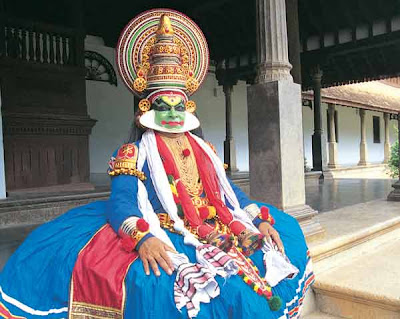
1. Angika -- pertaining to the body and its limbs. 2. Vachika -- relating to the vocal including proper pronunciation, modulation of voice accents and percussion.
3. Satvika -- representation of psychic condition.
4. Ahraya -- costume, make-up, stage props etc.
Vachika Abhinaya: One of the distinguishing characteristic of Kathakali is that the actors do not speak. Vachika (drama text in the form of verses and songs) are recited and sung by vocalists. These songs are explained and interpreted in details by actors through an elaborate method of angikabhinaya which consists of highly codified gestures, facial expression, and body movements. The vocal music in Kathakali although based on the Karnatic (South Indian) system has developed a distinct regional style called Sopanasangeetham. Its main aim is the evocation of the appropriate, dramatic mood and sentiments.
Sringara (EROTIC) Rati (LOVE) Hasya (COMIC, HUMOR) Hasa (LAUGHTER) Karuna (PATHETIC) Soka (SORROW) Raudra (FURIOUS) Krodha (ANGER) Veera (HEROIC) Visaha (ENERGY, HEROISM) Bhayanaka (TERRIBLE) Bhayam (FEAR) Atbhutam (MARVELOUS) Vismayam (ASTONISHMENT) Sandham (SERENE) Sama (TRANQUILLITY)

Traditionally there are 101 classical Kathakali stories. Most of them were initially composed to last a whole night. Nowadays there is increasing popularity for concise versions of every story (lasting 2-4 hours instead of a whole night), which has been made by selecting the most dramatic or popular portions of individual stories. In spite of being a classical art form, Kathakali can be appreciated by novices and connoisseurs. This is because of the frequent use of “Lokadharmi” (or the elaboration of folk elements)which allows novices to gain a foothold when they start watching Kathakali. In contrast “Natyadharmi” (which is based on the Natyasastra-the science of Natya and is the more classical component of the art form) delights the experience of novices and connoisseurs alike. It is good to have an idea of the story being enacted. This will help the spectators to appreciate the “personalization” of characters by individual actors. In fact one of the major attractions for traditional Kathakali connoisseurs is their ability to distinguish and debate on the "personalizations" that each actor brings about in his depiction of the story. Often this is a challenging task as most the characters and stories are derived from Hindu epics, which are memorized for people from that region. Success/ failure of amateur Kathakali artistes is often decided by their sensibility to successfully personalize characters. The most popular stories enacted are Nala Charitam (a story from the Mahabharata, Duryodhana Vadham (a story from the Mahabharata), Kalyanasowgandhikam (the story of Bhima going to get flowers for Panchali, from the Mahabharata), Keechaka Vadham (another story of Bhima and Panchali, from the Mahabharata), Kiratham (Arjuna and Lord Shiva's fight, from the Mahabharata), Karna Shapadham (another story from Mahabharata). Recently, as part of an attempt at popularizing the art, stories from other cultures, such as the story of Mary Magdalene from the Bible, Homer's The Iliad, and Shakespeare's King Lear have also been adapted into Kathakali scripts.  Kathakali adaptation of King Lear staged at the London Globe (1999)
Music The language of the songs used for Kathakali is a mix of Malayalam and Sanskrit. called Manipravaalam. Even though the songs are set for “ragas” based on South Indian Classical Music” (Karnatic Music), there is a distinct style of rendition, which is known as the “sopanam” style. The Sopanam style incorporates the moods of temple songs which used to be sung (continues even now at some temples) at the time when Kathakali was born.


CONCLUSION
Is Kathakali classical? If we look at our benchmarks to see if it is classical, it only scores modestly. It is definitely old, but this is one of the least important of the criteria. It is not necessarily something that upper classes use to define their identity, indeed the opposite is probably true. Its most glaring deficiency is seen in its inability to transcend its attachments to the Keralite community. The average Indian (non-Malayali) has only a vague knowledge that it exists, and will live their entire life without ever even seeing a Kathakali performance. Therefore from a sociological standpoint it is probably more correct to call Kathakali "traditional" instead of classical.
The most popular Kathakali artists have obtained their training from one the four centers below, which follow the traditional "gurukula" style. Moreover these four centers are the oldest ones with some of them present from pre-independent era of India.
PSV Natya Sanghom (located in Kottakal, near Kozhikode, Kerala)
Gandhi Seva Sadan Kathakali and Classic Arts Academy (located in Perur, near Palakkad, Kerala) and
 Kathakali, literally means `story-play', is a dance-drama originated in the 17th century in Kerala, one of the smallest and most beautiful states in India lying on the west coast of the Indian peninsula. It was given its present form by Mahakavi Vallathol Narayan Menon, who was the founder of the Kerala Kala Mandalam. Elements of music, dance , painting, poetry and drama beautyfuly blended in a unique way to make this art form stand out amongst other classical dance forms. Kathakali has evolved from classical dance forms such as Koodiyattam and also imbibed elements of several folk art forms that existed in Kerala. The many aspects of traditional rituals and ceremonies that Kathakali picked up on its evolutionary course from various folk arts, has since then become its integral part. Kathakali is known for its large, elaborate makeup and costumes. Characters with vividly painted faces and elaborate costumes re-enact stories from the Hindu epics, Mahabharata and Ramayana. The elaborate costumes of Kathakali have become the most recognised icon for Kerala
 It was one of the Rajas (Chieftain) of Kottarakkara, who wrote the first play intended for Kathakali performance. They form a cycle of eight stories based on Ramayana. The performance for each story was designed to last for six to eight hours and the performed stories were then known as Ramanattom (play pertaining to Rama), which later came to be called as Kathakali. Stories based on other epics and puranas were added to its repertoire in later period. A vivid picture of the nature of performance of Kathakali in the past is not known. However, it is said that in the beginning the actors themselves used to sing the text while performing. Masks were elaborately used for some characters and percussion was limited to a Chenda, Shuddha Maddalam (two headed barrel shaped drum), a Chengila (metal gong) and Elathalam (a pair of cymbals). Among the better known Kathakali play writes are Kottarakara Thampuran, the author of the above mentioned Ramayana Stories; Kottayam Thampuran, who wrote four stories based on Mahabharatha; Irayamman Thampi, who was both a good poet and composer, accredited three stories; Unnayi Warrier, the author of Nalacharitham (Story of King Nala); and Vayaskara Moosad who wrote one of the popular stories - Duryodhana Vadham.
 The themes of the Kathakali are religious in nature. They typically deal with the Mahabarat, the Ramayana and the ancient scriptures known as the Puranas. This is performed in a text which is generally Sanskritised Malayalam. A Kathakali performance is a major social event. They generally start at dusk and go through out the night. Kathakali is usually performed only by men. Female characters are portrayed by men dressed in women's costume. However, in recent years, women have started to become Kathakali dancers
KATHAKALI STYLES (Sampradayam)
- Vettathu Sampradayam
- Kalluvazhi Sampradayam
- Kaplingadu Sampradayam.
The latest Sampradyam is Kalluvazhy Sampradayam which is implemented in Kerala kalamandalam, Sadanam and Kottakkal. By selecting attractive attams from the Kaplingadu Sampradayam(Thekkan styles) and Kalladikkodan Sampradayam (old Vadakkan styles) and named as Kalluvazhi Sampradayam. Now Kalluvazhi Sampradayam is known as vadakkan style and Kalladikkodan Sampradayam is vanished. In Kalamandalam thekkan style of Kathakali training also included.
Unique Features
The three unique and striking features that make Kathakali an unparalleled form of performing art are
1. Sophisticated language of Mudras : with 24 basic Mudras (hand and finger gestures ) Kathakali has a total sophisticated language. When the drama is enacted on the stage, Kathakali characters communicate with each other through this sophisticated language, body movements and facial expressions. 600 to 700 gestures are there in common use.
2. Complete control of the eye balls and the different muscles in the face, so that the different emotions could be expressed and exhibited in a superb manner. (For instance the Kathakali artistes can rotate the eyeballs clockwise or anti-clockwise from corner to corner both ways etc.)
3. Flexibility and complete control of all part of the body. This is achieved by intensive physical training and oil massaging (Uzhichil) of the body. It takes years for a Kathakali artist to master the above said features.
Etymology
The name Kathakali derives from the Malayalam words "katha" (meaning story) and "kali" (meaning play)
Classical elements of Kathakali
Kathakali is considered to be a combination of five elements of fine art:
Natyam (Expressions, the component with emphasis on facial expressions)
Nritham (Dance, the component of dance with emphasis on rhythm and movement of hands, legs and body)
Nrithyam (Enactment, the element of drama with emphasis on "mudras", which are hand gestures)
Geetha (Song/Vocal accompaniment)
Vadyam (Instrument accompaniment)
Even though the lyrics/literature would qualify as another independent element called "Sahithyam", it is considered as a component of Geetha, as it plays only a supplementary role to Nritham, Nrithyam and Natyam.
Structure of the Performance
In olden days Kathakali performance mostly took place on a temple premises or at the house of a local land lord. For a typical performance, a simple temporary pandal (canopy made of thatched roof) at a height of 101/2 feet will be erected. A minimum of 12 feet-square (144 sq. feet) is needed for the acting area. A green room will also be located close to the stage. The stage will be decorated with coconut leaves, bunches of areca nuts etc. The only source of light is a big bell metal lamp placed down the center stage called "Aatta Vilakku or Kali Vilakku"(“kali”= dance; “vilakku”= lamp). Traditionally, the lamp used to provide light when the plays used to be performed. The level of the stage used to be the same as that of the ground where people used to squat while witnessing the performance.
 Kelikottu at about 6 `o clock in the evening will announce the performance of the evening. Kelikottu is a brief passage of drumming involving Chenda, Maddalam, Chengila and Elathalam. The actual performance will begin only between 9:00 - 10:00 PM. Arrangukeli will announce the beginning of the performance. This is a passage of drumming, which is followed by Thodayam, a piece of abstract dance at the same time are invocatory in nature. Thodayam is performed by junior actors in the group with simple make-up. Recitation of Vandanaslokam (Prayer Song), followed by Purappad - traditionally a preliminary item introducing the main character of the story in full costume and make-up. However, now-a-days it is mostly Krishna and Balarama who are presented, sometime with their spouses in this introductory dance. Next is the Melappadam, which is a musical piece where vocalists and the drummers are given opportunity to show their skill without depending on the actors. Then the story or part of the stories proposed are enacted which may last till dawn. The end of the performance is marked by a piece of pure dance called Dhanasi.
 Techniques
Kathakali is a dance-drama in which a high degree of stylization is seen in the method of acting, presentation, make-up and costuming. Realism is limited only to certain characters. The acting mode of Kathakali in its totality can be better understood in terms of four fold scheme of historic representation given in Natyasastra. They are:
1. Angika -- pertaining to the body and its limbs. 2. Vachika -- relating to the vocal including proper pronunciation, modulation of voice accents and percussion.
3. Satvika -- representation of psychic condition.
4. Ahraya -- costume, make-up, stage props etc.
Angika Abhinaya: This involves the whole body of the actor and included an elaborate scheme of facial expression, mime, gestures, accompanied by their appropriate movements, poses and attitudes. Dance passages known as Kalasams have an important role to play in Kathakali. While sustaining as a pure dance, it is also meant to enhance the appropriate bhavas. Hand gestures is another integral part of Angika since the interpretation of the text is mainly conveyed through this. Hastalakshna Deepika is the regional text on the Hastas (hand gestures) mainly used in Kathakali.
Vachika Abhinaya: One of the distinguishing characteristic of Kathakali is that the actors do not speak. Vachika (drama text in the form of verses and songs) are recited and sung by vocalists. These songs are explained and interpreted in details by actors through an elaborate method of angikabhinaya which consists of highly codified gestures, facial expression, and body movements. The vocal music in Kathakali although based on the Karnatic (South Indian) system has developed a distinct regional style called Sopanasangeetham. Its main aim is the evocation of the appropriate, dramatic mood and sentiments.
Satvika Abhinaya: A highly stylized technique in the invocation of bhava has been developed in Kathakali. This is called Rasabhinava. Indian dramatic theory explain 9 kinds of basic sentiments, Rasa with a corresponding sthayi bhava (emotional stayi mood). They are:
Sringaaram (amour), Haasyam (ridicule, humour), Bhayam (fear), Karunam (pathos), Rowdram (anger, wrath), Veeram (valour), Beebhatsam (disgust), Adbhutham (wonder, amazement), Saantham (tranquility, peace). The link at the end of the page gives more details on Navarasas.
Rasabhinava
Sthayi Bhava
Sringara (EROTIC) Rati (LOVE) Hasya (COMIC, HUMOR) Hasa (LAUGHTER) Karuna (PATHETIC) Soka (SORROW) Raudra (FURIOUS) Krodha (ANGER) Veera (HEROIC) Visaha (ENERGY, HEROISM) Bhayanaka (TERRIBLE) Bhayam (FEAR) Atbhutam (MARVELOUS) Vismayam (ASTONISHMENT) Sandham (SERENE) Sama (TRANQUILLITY)
Through a systematic process of practice an actor gain a full control of the facial muscles which enables him to express the bhavas. Apart from the above sets of emotional moods Natyasastra lists another set of 8 moods which is called Satvika Bhavas compared to Angikabhinaya this is more subtle and involuntary. Through an internal discipline an actor develops his ability in mastering this action technique. This will help the actor to go deeper into the characterization of the role in proper situation in the play.
Aharya Abhinaya:- The make-up and costuming is another important factor of the dance-drama. Such an elaborate system is rarely found elsewhere. The characters in Kathakali are types. As such characters are classified under 5 major types. According to their nature. They are: Pacca (Green), Kathi (Knife), Thaadi (Beard), Kari (Black), Munukku (Shining)
Kathakali plays
Traditionally there are 101 classical Kathakali stories. Most of them were initially composed to last a whole night. Nowadays there is increasing popularity for concise versions of every story (lasting 2-4 hours instead of a whole night), which has been made by selecting the most dramatic or popular portions of individual stories. In spite of being a classical art form, Kathakali can be appreciated by novices and connoisseurs. This is because of the frequent use of “Lokadharmi” (or the elaboration of folk elements)which allows novices to gain a foothold when they start watching Kathakali. In contrast “Natyadharmi” (which is based on the Natyasastra-the science of Natya and is the more classical component of the art form) delights the experience of novices and connoisseurs alike. It is good to have an idea of the story being enacted. This will help the spectators to appreciate the “personalization” of characters by individual actors. In fact one of the major attractions for traditional Kathakali connoisseurs is their ability to distinguish and debate on the "personalizations" that each actor brings about in his depiction of the story. Often this is a challenging task as most the characters and stories are derived from Hindu epics, which are memorized for people from that region. Success/ failure of amateur Kathakali artistes is often decided by their sensibility to successfully personalize characters. The most popular stories enacted are Nala Charitam (a story from the Mahabharata, Duryodhana Vadham (a story from the Mahabharata), Kalyanasowgandhikam (the story of Bhima going to get flowers for Panchali, from the Mahabharata), Keechaka Vadham (another story of Bhima and Panchali, from the Mahabharata), Kiratham (Arjuna and Lord Shiva's fight, from the Mahabharata), Karna Shapadham (another story from Mahabharata). Recently, as part of an attempt at popularizing the art, stories from other cultures, such as the story of Mary Magdalene from the Bible, Homer's The Iliad, and Shakespeare's King Lear have also been adapted into Kathakali scripts.
Music (Sangeetham)
Kathakali adaptation of King Lear staged at the London Globe (1999) Music The language of the songs used for Kathakali is a mix of Malayalam and Sanskrit. called Manipravaalam. Even though the songs are set for “ragas” based on South Indian Classical Music” (Karnatic Music), there is a distinct style of rendition, which is known as the “sopanam” style. The Sopanam style incorporates the moods of temple songs which used to be sung (continues even now at some temples) at the time when Kathakali was born.

Enactment of a play by actors takes place to the accompaniment of music (geetha) and instruments (vadya). The percussion instruments used are Chenda, Maddalam and Edakka. In addition the singers (usually the lead singer is called “ponnani” and his follower is called “singidi”) use "Chengala" (a round disc made of bell metal, which can be struck with a wooden stick) and "Ilathaalom" (a pair of cymbals). The lead singer in some sense uses the Chengala to conduct the Vadyam and Geetha components, just as a conductor uses his wand in western classical music. A distinguishing characteristic of this art form is that the actors never speak and use hand gestures, expressions and rhythmic dancing instead of dialogue.

The costume is the most distinctive characteristic of Kathakali. The makeup is very elaborate and the costumes are very large and heavy. One of the most interesting aspects of Kathakali is its elaborate make-up code. Most often, the make-up can be classified into five basic sets namely Pacha, Kathi, Kari, Thaadi, and Minukku. The differences between these sets are the predominant colors that are applied on the face. Pacha (Pacha=green) has green as the dominant color and is used to portray noble heroic and devine male characters who is said to have a mixture of "Satvik" (pious)and "Rajasic" (kingly) nature, eg; Krishna, Arjuna etc. Kathi (Knife) is used to Rajasic characters having an evil streak ("tamasic"= evil), such as the demon king Ravana, Duryodhana are portrayed with red as the predominant color in a green background. These are heroic charecters but lustful with arogant in nature. Thaadi (Beard) is for excessively evil and villainous characters such as demons (totally tamasic) have a predominantly red make-up and a red beard. They are called Chuvanna Thaadi (Red Beard). Kari: Tamasic characters such as uncivilized hunters are represented with a predominantly black make-up base and a black beard and are called Kari/ Karutha Thaadi (meaning black beard).
Minukku (Shining): All female (ecepct Demoness in their orginal form) and ascetics have lustrous, yellowish faces and form the fifth class. For example Brahmins, Sage, Messangers, Charioteer etc.
Teppu (Special make-up): This costume is using for portraying Birds, Bheeru (Coward) etc.
In addition there are modifications of the five basic sets described above such as Vella Thaadi (white beard) used to depict Hanuman (the monkey god) and Pazhuppe, which is used for the Sun God.
The make up is made from various mineral ores and pigments. The materials that comprise the makeup is all locally available. The white is made from rice flour, the red is made from Vermilion (a red earth such as cinnabar). The black is made from soot. They are ground on a stone and mixed with coconut oil before being applied on the face. Some characters also have their features enhanced, such as an enlarged nose or an elaborate mustache. There are made using elaborately cut paper which is stuck to the face with a mixture of rice paste and calcium carbonate. Dancers also often place a "chundanga seed" (variety of eggplant which bears small fruits) under their lower eyelid before the performance to turn the white of their eyes red. In fact the "chundanga" is not really a seed and is prepared by removing the ovaries at the base of the flowers of this plant. The procedure used for preparing these seeds involves the rubbing of a bunch of these in your palm until they become black (starting from a white color) and nearly dehydrated. They often last long enough for a season (of around four months) in this condition. The colours are not merely decoration, but are also a means of portraying characters. For instance, red on the feet is used to symbolise evil character and evil intent.
A major part of the face make-up is done by the actor himself. However, specially trained artists are entrusted to apply Chutty (framing the face with white paper and rice paste). Design vary according to the type of a characters. A close observation on Aharya aspect of Kathakali would reveal the highest level of aesthetic imagination conceived by our predecessors.
Acting
A Kathakali actor uses immense concentration, skill and physical stamina, gained from training based on Kalaripayattu, the ancient martial art of Kerala, to prepare for his demanding role. Training can often last for 8-10 years. The training programme is intensive. In Kathakali, the story is enacted purely by the movements of the hands (called mudras or hand gestures) and by facial expressions (rasas) and bodily movements.
The expressions are derived from Natyasatra (the science of expressions) and are classified into nine as in most Indian classical art forms. Dancers also undergo special practice sessions to learn control of their eye movements. There are 24 main mudras and numerous other lesser mudras. Each can again can be classified into 'Samaana-mudras'(one mudra symbolizing two entities) or misra-mudras (both the hands are used to show these mudras). The mudras are a form of sign language used to tell the story. The main facial expressions of a Kathakali artist are the 'navarasams' ( 'Navarasas' in anglicised form )(literal translation: Nine Tastes, but more loosely translated as nine feelings or expressions) which are Sringaaram (amour), Haasyam (ridicule, humour), Bhayam (fear), Karunam (pathos), Rowdram (anger, wrath), Veeram (valour), Beebhatsam (disgust), Adbhutham (wonder, amazement), Saantham (tranquility, peace). The link at the end of the page gives more details on Navarasas.
CONCLUSION
Is Kathakali classical? If we look at our benchmarks to see if it is classical, it only scores modestly. It is definitely old, but this is one of the least important of the criteria. It is not necessarily something that upper classes use to define their identity, indeed the opposite is probably true. Its most glaring deficiency is seen in its inability to transcend its attachments to the Keralite community. The average Indian (non-Malayali) has only a vague knowledge that it exists, and will live their entire life without ever even seeing a Kathakali performance. Therefore from a sociological standpoint it is probably more correct to call Kathakali "traditional" instead of classical.
Renowned training centers for Kathakali
The most popular Kathakali artists have obtained their training from one the four centers below, which follow the traditional "gurukula" style. Moreover these four centers are the oldest ones with some of them present from pre-independent era of India.
Kerala Kalamandalam (located in Cheruthuruthy, near Shoranur, Kerala)
PSV Natya Sanghom (located in Kottakal, near Kozhikode, Kerala)
Gandhi Seva Sadan Kathakali and Classic Arts Academy (located in Perur, near Palakkad, Kerala) and
Unnayi Varier Smaraka Kalanilayam (located in Iringalakuda, near Thrissur, Kerala)
There also several new centers, but they are relatively new compared to these old schools where masters of the art such as Kalamandalam Ramankutty Nair (recipient of prestigious Kalidas award) and Keezhpadom Kumaran Nair (recipients of prestigious Padmashree award) and contemporaries trained their disciples.
Margi Kathakali Vidyalayam and Kalabharathi Kathakali Vidyalayam, FACT Kathakali School, RLV Kathakali vidyalayam, Trippunitura also conducting Kathakali classes.
Here we see Parvati, the wife of Siva, trying to intercede between her husband and Arjuna. Since Siva likes Arjuna really, she eventually succeeds. Arjuna has learnt a little humility so Siva presents him with a magic arrow.